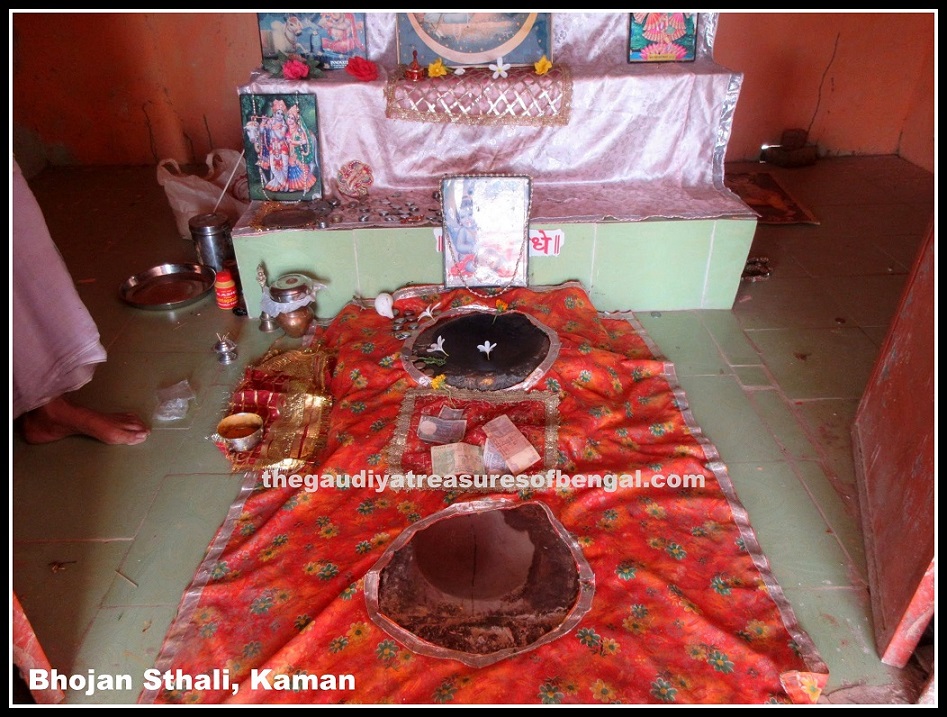
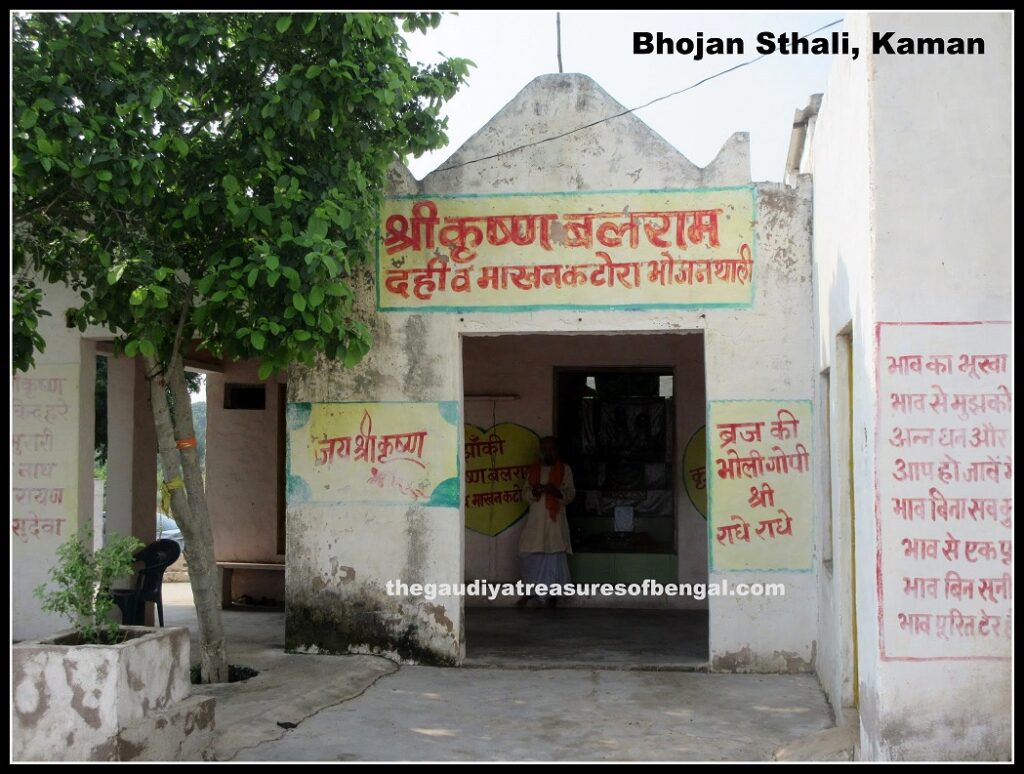
Located on the eastern side of Kalavata village, near Kaman, lies Bhojan Sthali, a place where Lord Krishna frequently dined with His cowherd companions. To access this spot, one can either cross the stream from Vyomasur-gupha or follow a straight path from Kaman. Interestingly, the rock surface at this location still bears the imprints of the bowls and plates that Krishna used during His meals. Bhojan Sthali is situated in close proximity to Krishna Kunda, also known as Ksirsagara, where Lord Krishna took a refreshing bath after slaying Vyomasura. Moreover, adjacent to Bhojan Sthali is Bajani Sila, a nearby spot where Krishna and His friends used a stone as a musical instrument after their lunch. The act of Lord Krishna getting ready to relish a meal with His friends is described in the following shloka mentioned in Srimad Bhagavatam –
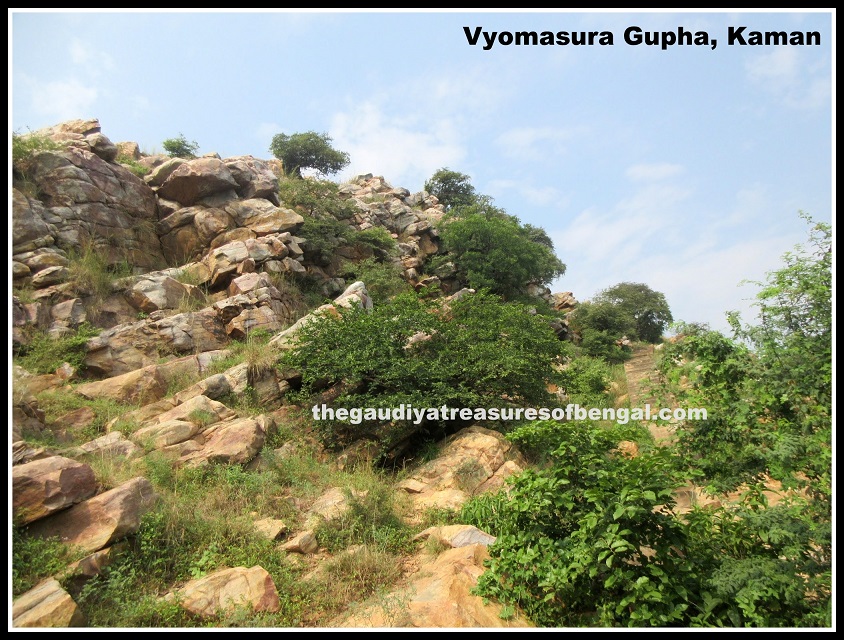
North of the Kalavata village, near Kaman (Kamyavan), on a hilltop, lies the famous cave of Vyomasura (Vyomasura Gupha). This cave holds great significance as it was the place where Lord Krishna killed the demon Vyomasura to rescue his cowherd friends who were held captive by the demon.
It all started when Krishna and his friends were playing the game of “cops and robbers” on the Govardhan hill. Some say that Krishna and His friends were playing near Kamyavan on that day. The demon Vyomasura, who had the ability to fly in the sky, appeared in the guise of a cowherd boy and started stealing the boys, sealing them in his cave with stones. But Krishna, being the all-knowing and all-powerful Lord, understood the demon’s trickery and quickly caught hold of him. The demon tried to transform himself into a mountain to escape, but Krishna’s grip was too strong.
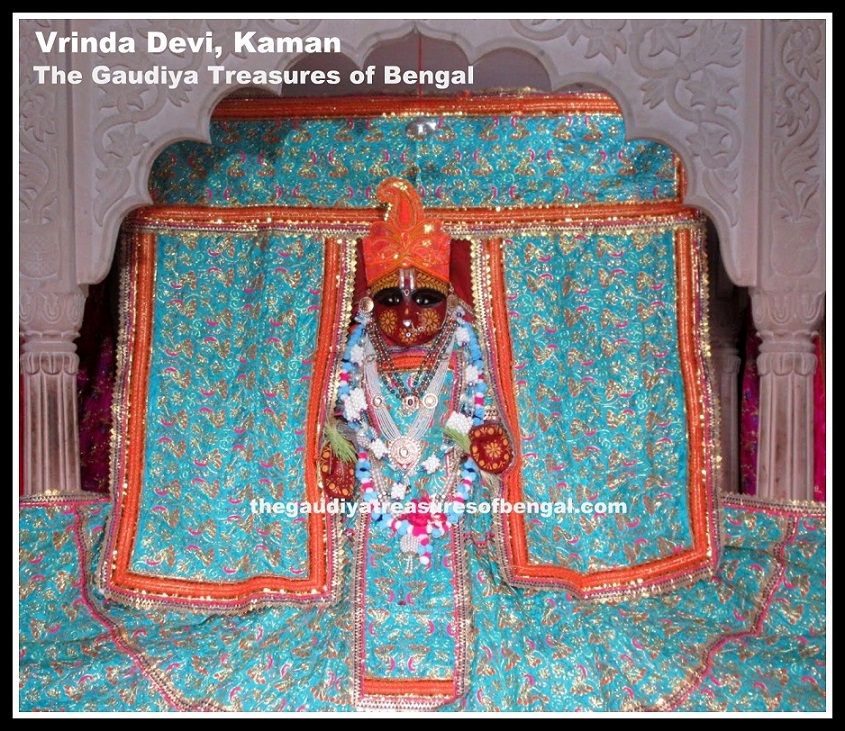
The town of Kaman, Rajasthan is home to a revered temple, the Vrinda devi and Radha Govinda temple, which occupies a central position within the town. The temple is famous for the presence of the deities enshrined within its walls. Of particular note is the deity of Vrinda Devi, who was originally installed by the Vajranabha, great grandson of Krishna, approximately 5,000 years ago.
Years later, Rupa Goswami rediscovered the deity on the banks of Brahma Kunda in Vrindavan and installed her in a small temple adjacent to the Radha Govinda temple in Vrindavan. However, due to the tumultuous political climate of the time, the king of Jaipur ordered the transfer of Vrinda Devi, along with Radha Gopinatha, Radha Madana-Mohan, and Radha Govinda, to Jaipur to protect them from Mughal attack. The deities were loaded onto bullock carts and began the journey to Jaipur, but they made a stop for three nights in Kamyavan.
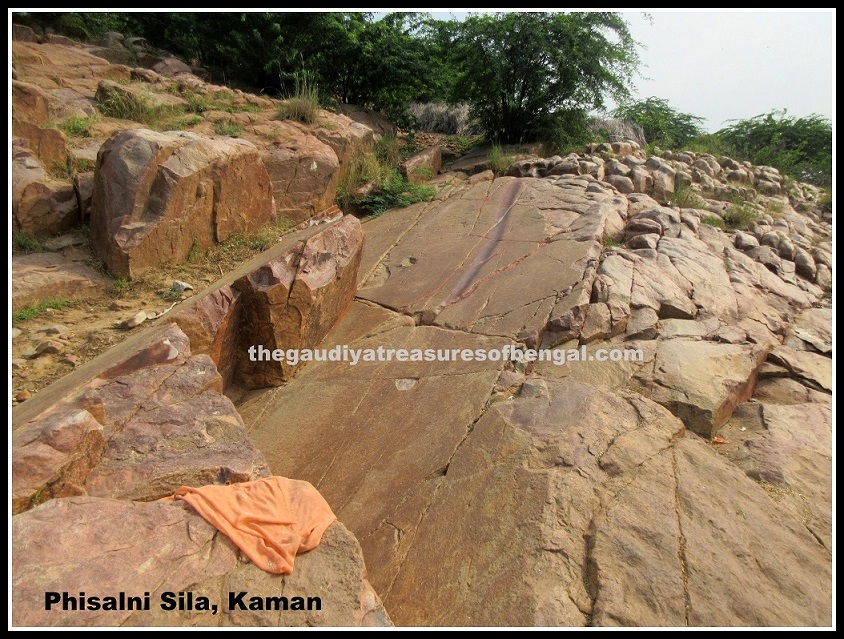
Phisalni Sila, an ancient sliding rock located near the Kalawata village in Rajasthan, has a rich history dating back five thousand years. It is also spelled as Fisalni Sila. According to local legends, Lord Krishna and His friends used to visit this spot while grazing their cows and enjoy sliding down the rock’s smooth surface. Likewise, Srimati Radharani and her sakhis have been said to visit this place and indulge in sliding down the rock.
In Brahma samhita, Lord Brahma praises Krishna as ‘Govindam Adi Purusham’, who is widely recognized by spiritualists in India and around the world as the Supreme Lord (Isvara Parama Krishna). Krishna is also considered as the original and oldest personality, without any superior (anadir adir Govinda), and the ultimate cause of all causes (sarva karana karanam). Lord Shiva, who is responsible for the destruction of the world, is regarded as Krishna’s great devotee (vaishnavanam yatha shambhu) and even holds the water of the Ganges that washed Krishna’s lotus feet on his head as a sign of respect. In the Bhagavad Gita, Krishna reveals that he is seated in everyone’s heart as the Paramatma (supersoul) and that remembrance, knowledge, and forgetfulness originate from him (Mattah smritir jnanam apohanam ca). He also controls the material nature (prakriti) that governs the living entities of this world (Mayadhyaksena prakrtih suyate sa caracaram). Maha Vishnu, who lies in the causal ocean, and from whose body pores the countless material universes emanate, is a partial expansion of Lord Krishna. This article will cover some of the most prominent Krishna temples in India.
Five thousand years ago, the province of Sindh (now situated in present-day Pakistan) was ruled by King Vimala, who resided in Champaka Nagari. Despite having six thousand queens, he had no children at first. However, Sage Yajnavalkya blessed him with ten million daughters. Interestingly, these daughters were all reincarnations of women from Ayodhya who, in their previous lives, yearned to be married to Lord Ramachandra. Unfortunately, their dreams were never fulfilled as Lord Rama vowed to accept only one wife. However, during the Dvapara Yuga, Lord Krishna descended and reciprocated with their long-cherished desires.
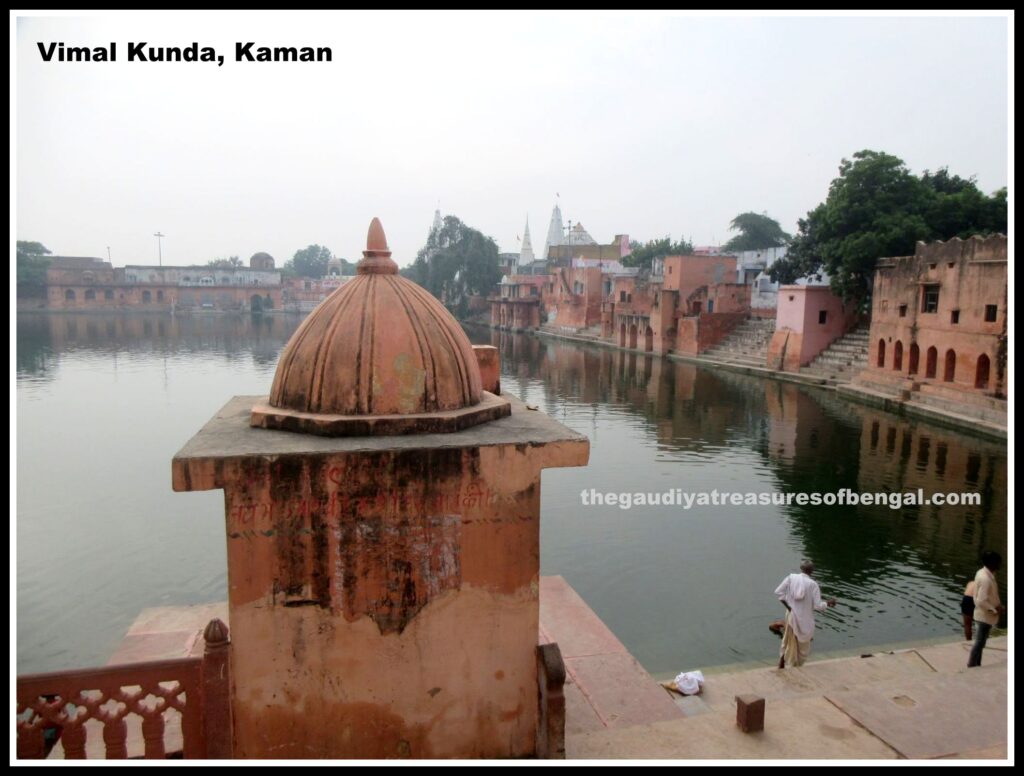
Upon reaching a marriageable age, King Vimala desired to marry all his daughters to Lord Krishna. Delighted by this request, Lord Krishna accepted and wedded all the princesses at Champaka Nagari. He then brought them to Kamyavan (Kaman) where He performed the Rasa dance with them. As there were as many princesses, Lord Krishna expanded into countless forms, and associated with them, thus fulfilling their ultimate dream. The tears of joy that flowed from these princesses created a pond now known as Vimal Kunda, where one can bathe and have all their material and spiritual desires fulfilled. It is believed that by bathing here, one can attain pure love for Lord Krishna.
There is another fascinating incident linked with Vimal Kunda. According to legend, during Chaturmasya, all the holy places manifest themselves in Vraja Mandala except for Pushkar, who failed to appear once. Lord Krishna hence remembered Yogmaya, who caused a powerful stream of water to gush out of the earth. From that sacred stream emerged a beautiful young girl with whom Lord Krishna frolicked and sported in the waters and bestowed His blessings upon her. From that day onwards, the girl came to be known as ‘Vimal Kunda’, and anyone who bathes in her waters is said to receive seven times more pious merit than bathing in Tirtharaj Pushkara.
According to the Adi Varaha Purana, taking a bath in Vimal Kunda absolves one of all their sins. Additionally, departing from one’s body at Vimal Kunda leads one to the Supreme Lord’s divine abode.
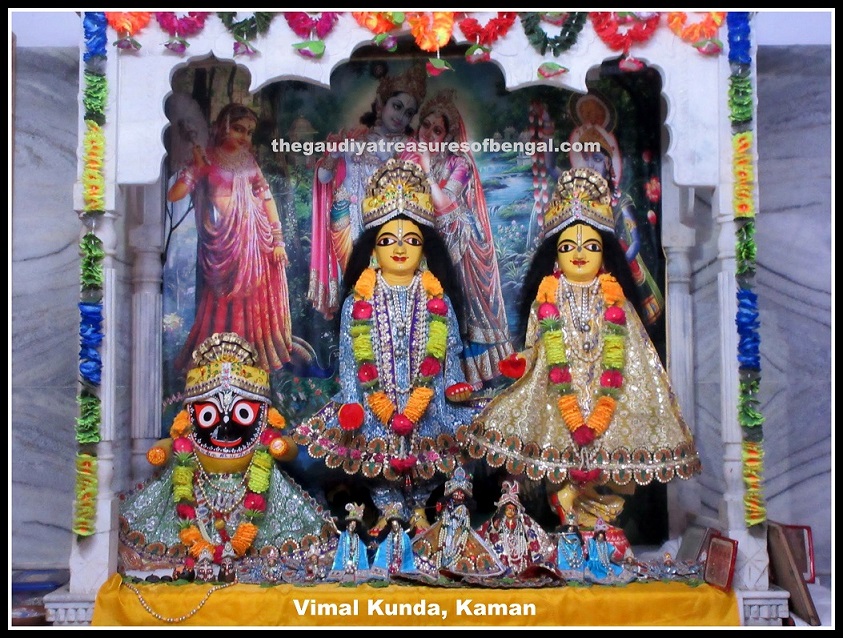
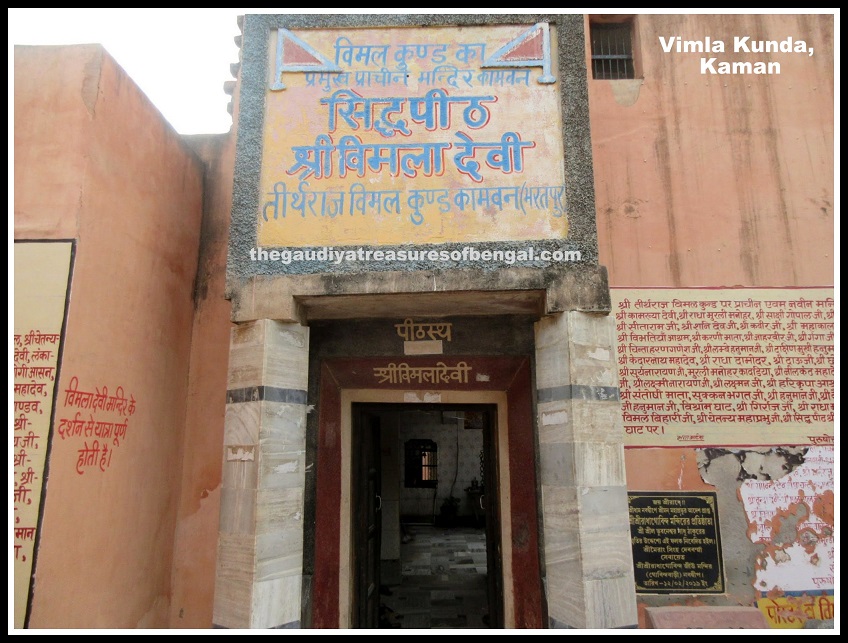
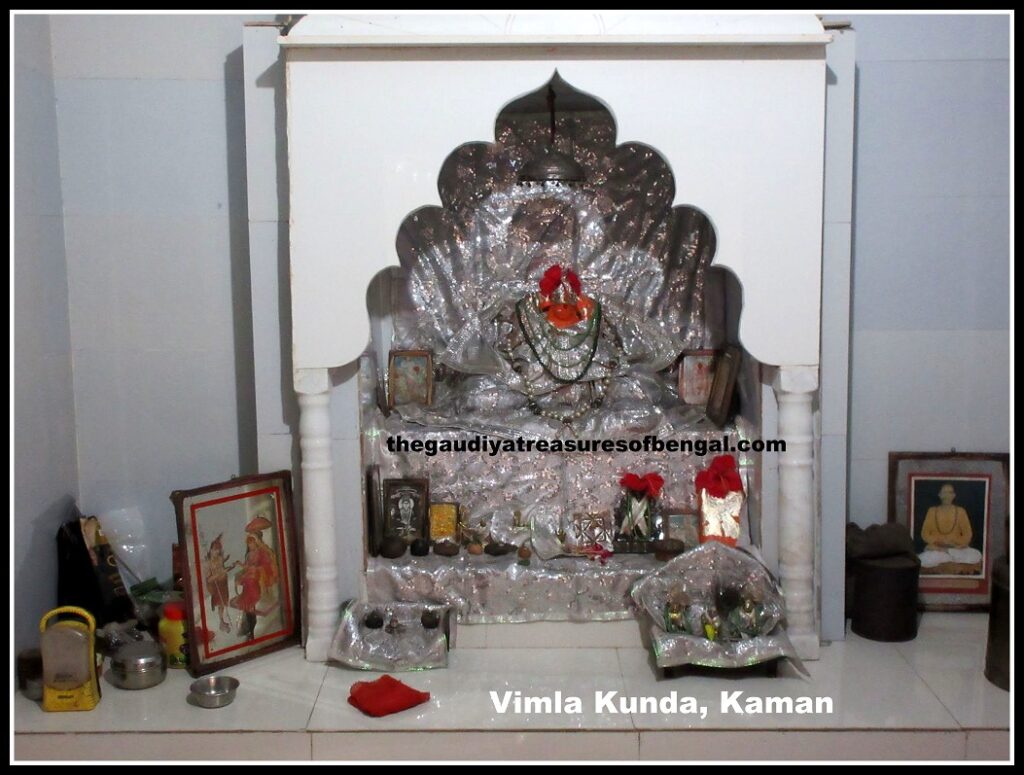
Vimal Kunda was an incredibly captivating place where the locals were warm and welcoming, kindly offering to give us a tour. Adjacent to the Vimal Kunda is the temple of Vimala Devi. Sri Chaitanya Mahaprabhu had visited this place during His Vraja Mandala Parikrama. Additionally, there is a magnificent temple of Lord Chaitanya, Lord Nityananda, and Lord Jagannath located next to the Vimala Devi temple. The deities surrounding Vimal Kund are arranged in the following sequence: (1) Dauji, (2) Suryadev, (3) Nilakanthesvar Mahadev, (4) Govardhan Nath, (5) Madan Mohan and Kamyavan Bihari, (6) Vimala Bihari, (7) Vimal Devi, (8) Shri Murali Manohar, (9) Bhagavati Ganga, and (10) Gopalaji.
How to Reach
Vimal Kunda is situated in the historic town of Kaman, which is part of the Bharatpur district in Rajasthan, India. Located roughly 70 kilometers away from Mathura, Vimal Kunda is positioned 4 kilometers from Kaman Police Station. The closest railway station is Deeg, which is approximately 19 kilometers away.
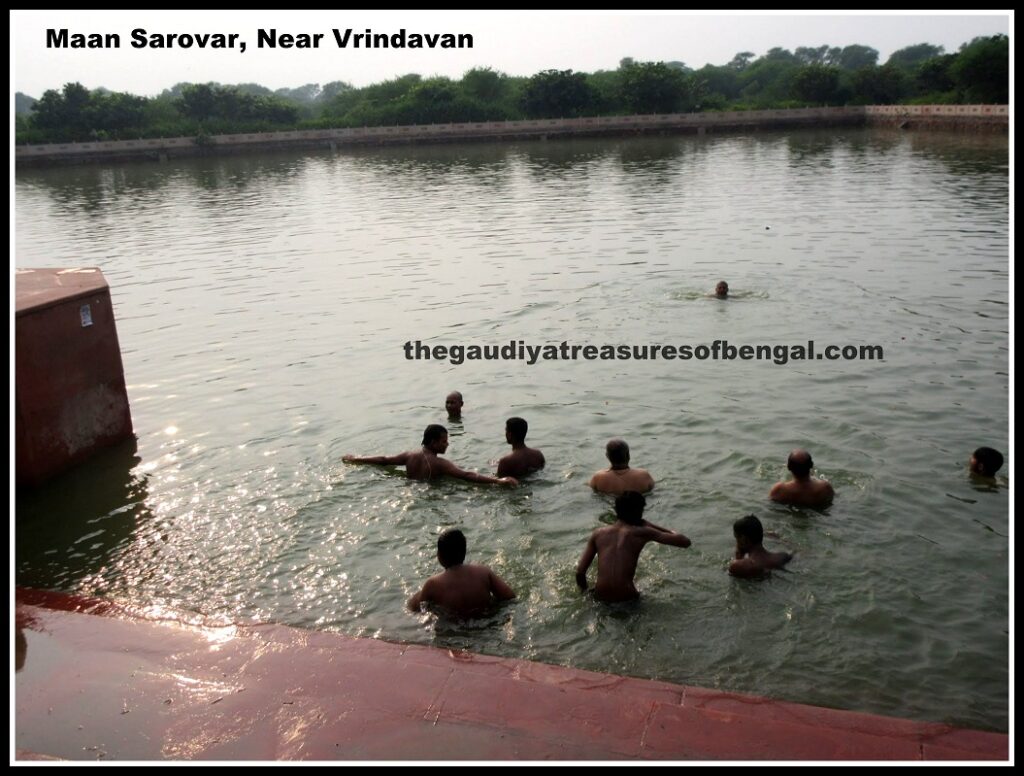
Maan Sarovar (Mansarovar) is located on the bank of Yamuna opposite to Vrindavan and is surrounded by serene forests. The name “Maan” signifies the lover’s anger, while “Sarovar” means lake. It is believed that Radharani, feeling jealous of Krishna’s dancing with other gopis during the Rasa Lila near the Yamuna river, expressed her anger and left the dance. She crossed the yamuna, came to Mansarovar and wept uncontrollably, and her tears formed the lake. Krishna eventually found her there and apologized by placing his flute and head at her feet. He promised never to repeat his actions. A painting depicting this scene is worshiped in an old temple on the bank of Maan Sarovar. Jayadeva Goswami in his gita govinda beautifully describes this pastime in the following words –
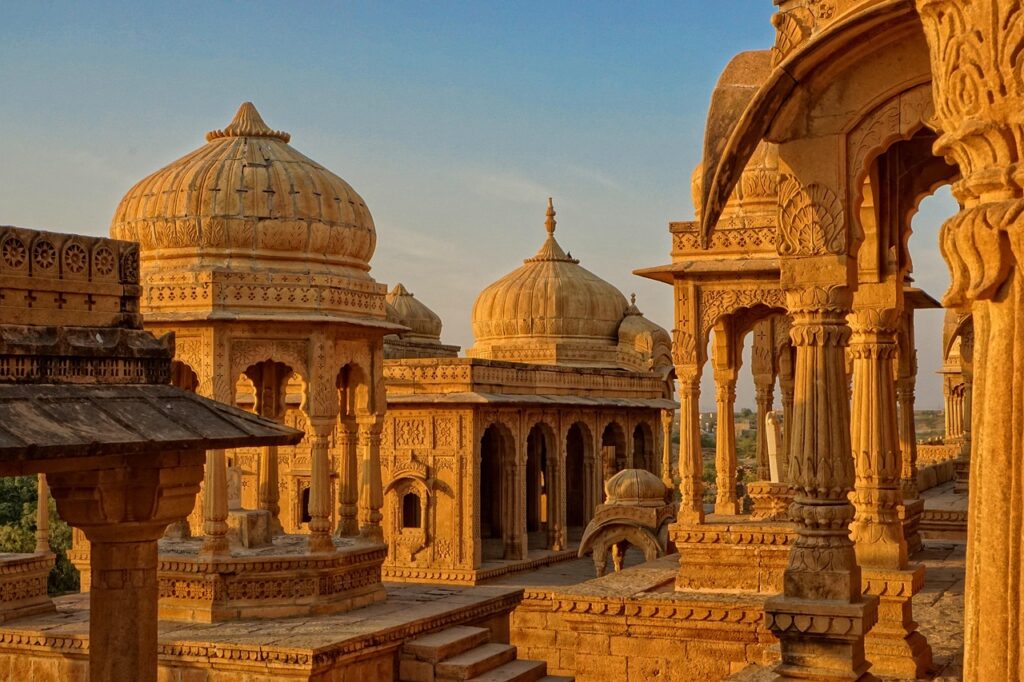
India, known for its spiritual serenity, is considered to be saturated with the essence of gods and goddesses, their enduring imprints, and an ever-present sense of divinity in the surrounding environment. The abodes of these deities, commonly known as temples, represent the magnificence of the ancient and culturally rich Hindu Sanatan Dharma. They are considered to be sacred places where devotees can connect with the divine and seek blessings from the deities. The architecture and design of temples in India vary widely depending on the region and the era in which they were built. Temples in India also serve as important centers of social and cultural activity. They are often the site of religious festivals and ceremonies, as well as community events like weddings and cultural performances. In many cases, the temple serves as the focal point of the community, bringing together people from all walks of life to celebrate and worship together. Overall, temples in India are a testament to the country’s rich spiritual and cultural heritage. They are not just places of worship, but also symbols of the enduring traditions and values that have shaped Indian society for millennia.
Uttarakhand, a state in northern India crossed by the Himalayas, boasts many holy places and welcomes devotees throughout the year. One of the most prominent religious circuits in Uttarakhand that devotees embark on is the Char Dham (4 Dham) Yatra. This pilgrimage involves visiting four revered sites – Yamunotri, Gangotri, Kedarnath, and Badrinath – nestled in the Himalayas. The term ‘char’ denotes four, and ‘dham’ signifies religious destinations in Hindi. Sometimes this pilgrimage is also referred to as ‘Chota Char Dham yatra’ or smaller 4 Dham yatra.
The high-altitude shrines remain closed for about six months each year, opening in summers (April or May) and closing with the onset of winter (October or November). The Char Dham Yatra is traditionally undertaken in a clockwise direction, beginning from Yamunotri and moving on to Gangotri, Kedarnath, and finally concluding at Badrinath. One can reach these sites by road or air (helicopter services are available). Some pilgrims also undertake a Do Dham (2 Dham) Yatra, which involves visiting two shrines – Kedarnath and Badrinath. Yamunotri temple, situated in a narrow gorge near the source of River Yamuna in the Uttarkashi district, is dedicated to the sacred personality of Yamuna, who is worshiped by devotees. The district of Uttarkashi is also home to Gangotri, dedicated to Goddess Ganga, India’s most sacred river. Kedarnath, located in the Rudraprayag district, is dedicated to Lord Shiva. Badrinath, home to the sacred Badrinarayan Temple, is dedicated to Lord Vishnu, the Supreme Lord. Undertaking the Char Dham Yatra is a challenging yet spiritual journey that provides nourishment to one’s soul.
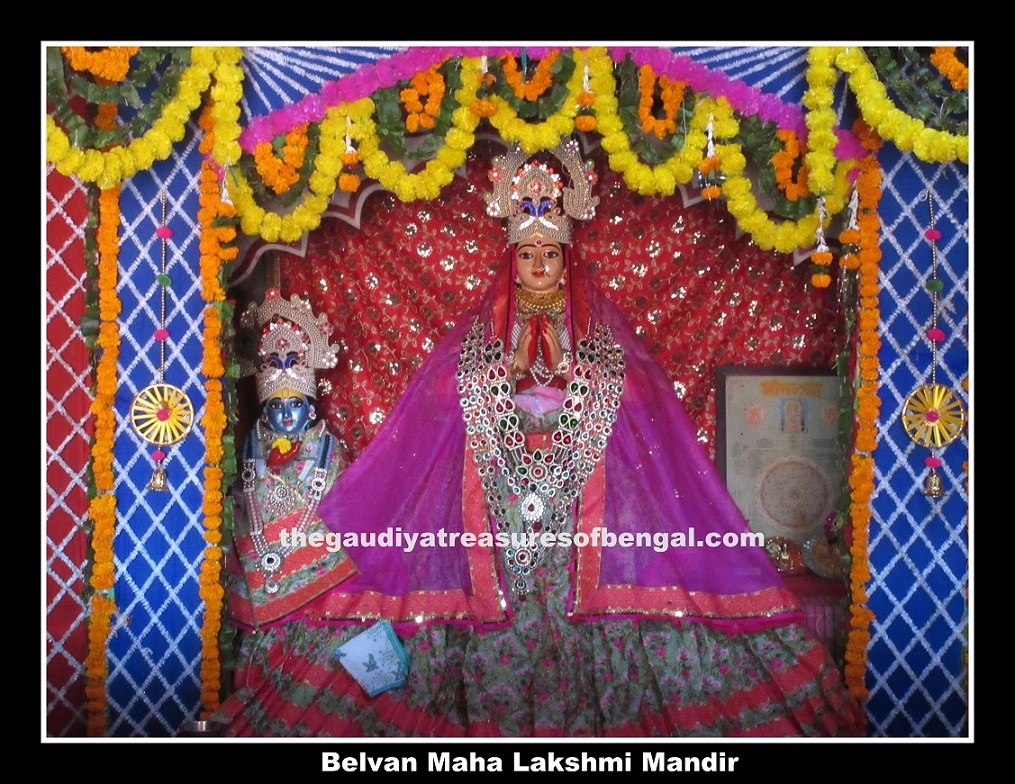
Belvan, which is the tenth forest of Vraja Mandala, got its name due to the plentiful bael (bilva) trees present during Krishna’s pastimes. As Krishna and His friends grazed their cows in Belvan, they engaged in various sports and enjoyed the ripe bael fruits available in the forest. This is described in Bhakti Ratnakara –
Ramakrishna sakha saha e bilvavanete pakka bilvaphala bhunje mahakautukete – At this location, Balarama, Krishna, and their companions celebrated and enjoyed consuming ripe bael fruits.
This website uses cookies to improve your experience while you navigate through the website. Out of these, the cookies that are categorized as necessary are stored on your browser as they are essential for the working of basic functionalities of the website. We also use third-party cookies that help us analyze and understand how you use this website. These cookies will be stored in your browser only with your consent. You also have the option to opt-out of these cookies. But opting out of some of these cookies may affect your browsing experience.
Necessary cookies are absolutely essential for the website to function properly. This category only includes cookies that ensures basic functionalities and security features of the website. These cookies do not store any personal information.
Any cookies that may not be particularly necessary for the website to function and is used specifically to collect user personal data via analytics, ads, other embedded contents are termed as non-necessary cookies. It is mandatory to procure user consent prior to running these cookies on your website.