Categories
Barsana, Yavat, Nandgaon

Pili Pokhar (Priya Kunda), Barsana – where Radharani washed her hands

pili pokhar barsana radharani

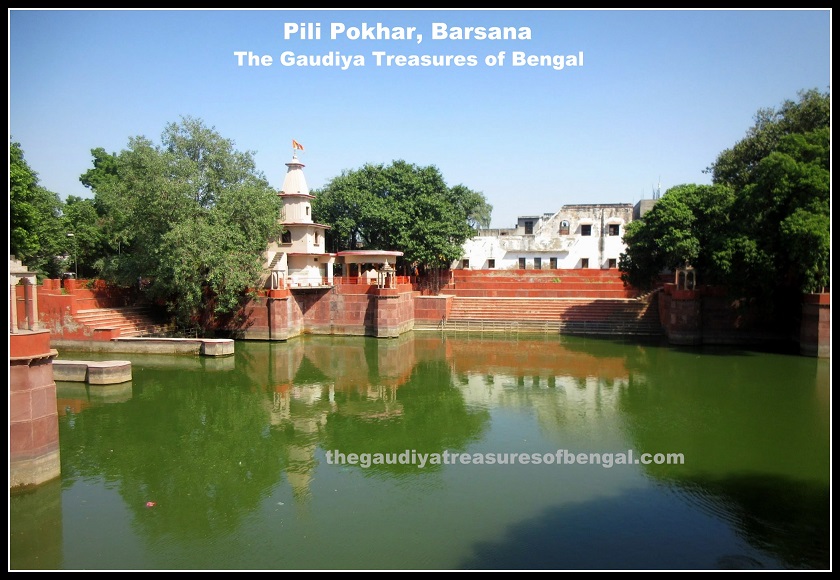
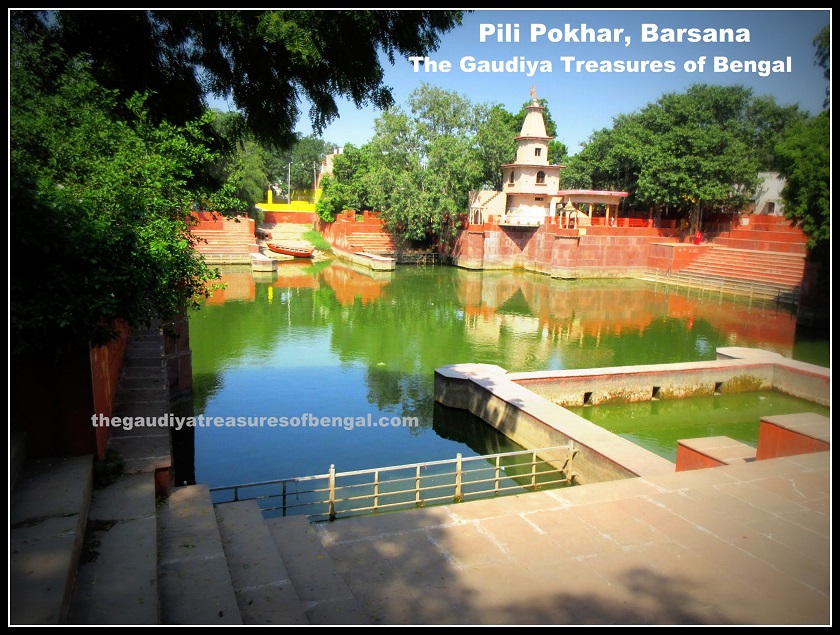
The word ‘Pili’ means yellow. Pili Pokhar, also known as ‘Priya Kunda’ is a yellowish pond situated in the village of Barsana, where Srimati Radharani had cleaned her hands. Once, Radharani visited Nandgaon, the residence of Nanda Maharaja, along with her friends. Mother Yashoda was so impressed with her captivating beauty and refined behavior, that she desired Krishna to marry her. It was a custom in the old days, for mothers-in-law to apply turmeric paste on the hands of their daughters-in-law. Harboring the desire to have Radharani as her daughter-in-law, mother Yashoda applied turmeric paste to her hands. On her way back home Radharani realized that her hands were yellow with Turmeric. She was embarrassed to think what her family members and the people of Barsana would think of her. Hence she rushed to the nearby lake and washed off her hands. The pond turned yellow and since then it came to be known as Pili Pokhar.
pili pokhar barsana radharani

The place is also known for the Pilu trees (toothbrush trees) that encircle the lake. Bhakti Ratnakara states that Piyala Sarovar or Pili Pokhar is where Radha and Krishna enjoyed various sporting activities along with their friends on the pretext of picking up the Pilu fruits.

Ei Pilukhor etha pilu-fol chhole
Sakhi-saha Rai-Kanu krira kutuhole
(Bhakti Ratnakara)

On the pretext of picking up Pilu fruits, Radha and Krishna would enjoy various sporting activities along with their friends, here at Pilu Khora (Pili Pokhar).
Categories
Barsana, Yavat, Nandgaon

Sankari Khor – Krishna’s Dana Lila | Vraja Mandala

Sankari Khor Barsana dana lila

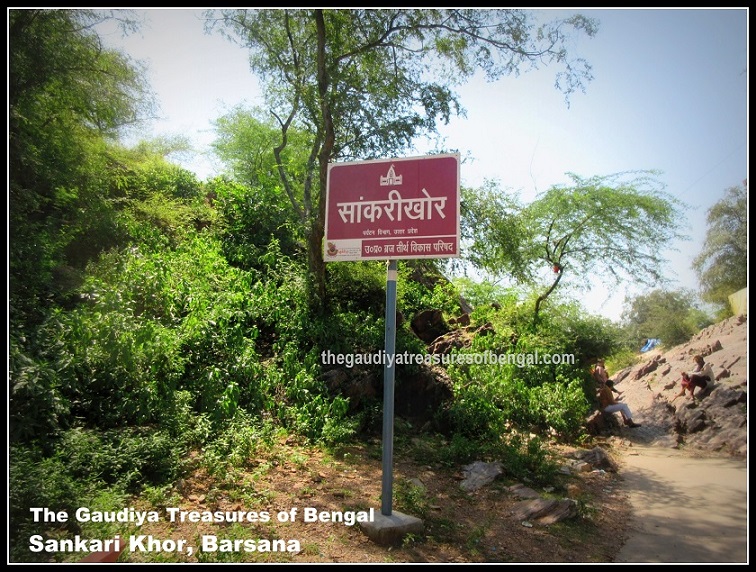
Padma Purana states that Lord Brahma had previously performed severe austerities with the desire to witness the pastimes of Radha and Krishna and obtain the dust of their lotus feet upon his head. Being pleased with Brahma, Krishna granted him the boon to manifest himself as mountains here at Barsana. As a result, Brahma manifested himself as the Brahmagiri mountains here at Barsana. Brahmagiri has four different peaks representing the four heads of Lord Brahma. There is a second hill situated right next to Brahmagiri known as Vilasa Parvata or Vishnu Parvata which is considered to be a manifestation of Lord Vishnu. The four peaks of these hills are – Bhangarh, Managarh, Danagarh, and Vilasgarh. Bhangarh (the highest of the four peaks) is where Vrishabhanu Maharaja had established his palace and where Radharani manifested her childhood pastimes. Sankari Khor is the narrow passage between Brahmagiri Parvata and the Vilasa Parvata. ‘Sankari’ means narrow and the word ‘Khor’ translates to lane. Hence ‘Sankari Khor’ refers to the narrow passage between the two mountains through which one can only pass in a single file. One might be lean or bulky but no matter how much one tries, only a single person can walk through Sankari Khor. It is impossible for two to walk side by side. It is here at Sankari Khor that Krishna manifested His  Dana Keli pastimes.

Categories
Barsana, Yavat, Nandgaon Radha Krishna

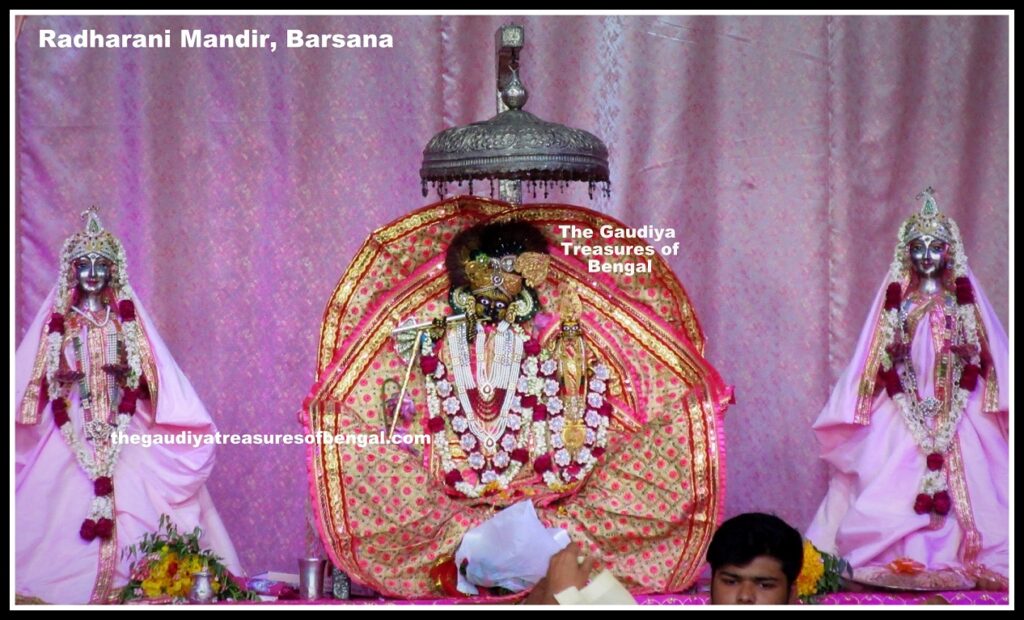
Barsana Radha Rani Mandir – History and Festivals | Vraja Mandala

Barsana Radha rani mandir

Radha Rani Mandir or the Sriji temple, situated on top of a hillock here at Barsana, houses captivating deities of Sri Radha and Krishna. Also known as ‘Ladli Mahal’, Barsana Radha Rani Mandir is a significant holy site of Vraja Mandala. Barsana, also known as Vrishabhanupur (named after Vrishabhanu Maharaja), is a village situated about 41 Kilometers northwest of Mathura. It is where Radha and Krishna manifest their eternal pastimes. Vrishabhanu Maharaja was a close friend of Nanda Maharaja, Krishna’s father. When Nanda Maharaja shifted his family from Gokul to Nandgaon, out of the fear of Kansa’s atrocities, Vrishabhanu Maharaja also shifted along with his family from Raval to Barsana. Padma Purana states that Lord Brahma had previously performed severe austerities with the desire to witness the pastimes of Radha and Krishna and obtain the dust of their lotus feet upon his head. Being pleased with Brahma, Krishna granted him the boon to manifest himself as mountains here at Barsana. As a result, this mountain is also known as Brahmagiri. Brahmagiri has four different peaks representing the four heads of Lord Brahma. There is a second hill situated right next to Brahmagiri known as Vilasa Parvata or Vishnu Parvata which is considered to be a manifestation of Lord Vishnu. The four peaks of these hills are – Bhangarh, Managarh, Danagarh, and Vilasgarh. Bhangarh (the highest of the four peaks) is where Vrishabhanu Maharaja had established his palace and where Radharani manifested her childhood pastimes. Bhakti Ratnakara describes the residence of Vrishabhanu Maharaja as follows –

Vrishabhanu-pura e, Barsana nama koy
Parvata samipe Vrishabhanura aloy
Apurva parvata – etha Vrajendrakumara
Karilena Dana-lila anya agochara
(Bhakti Ratnakara)

Behold Vrishabhanu-pura, which is also known as Barsana. Near this mountain is the residence of Vrishabhanu Maharaja. On this exotic mountain, Vrajendra Kumara Sri Krishna performs His dana-Lila pastimes concealed from the view of others.

Categories
Gokul, Raval & Dauji

Dauji Mandir, Baldeo Mathura | Who is Lord Balarama ?

dauji mandir baldeo balarama revati

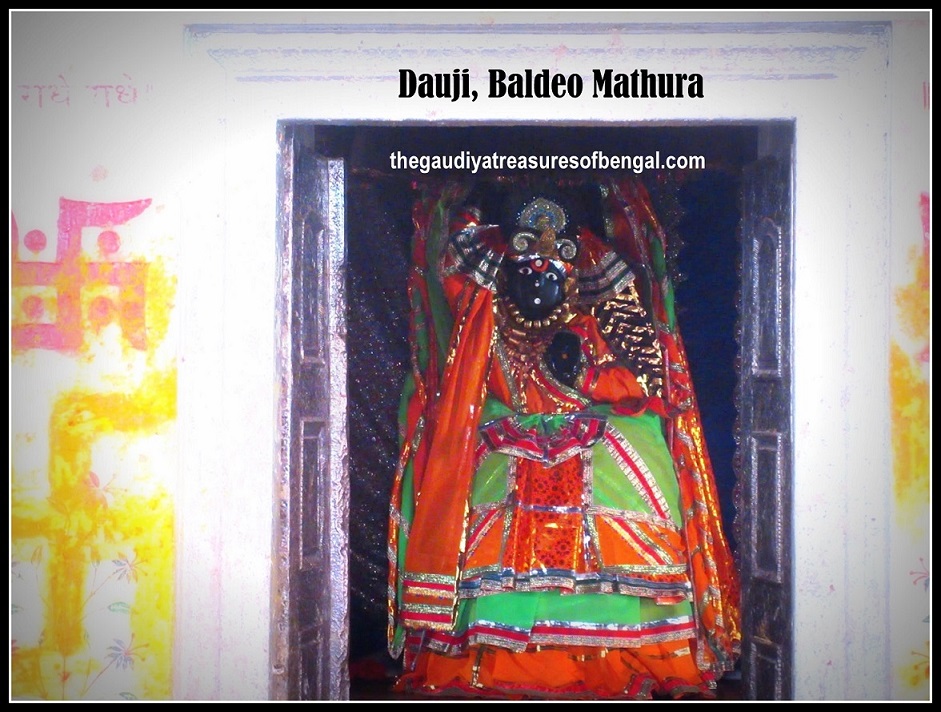
Dauji is another name for Balarama, the elder brother of Krishna. Here at Dauji Mandir Baldeo, we find the largest deity of Balarama in the entire Vraja Mandala. Life in the village revolves around this beautiful ancient temple. In fact, the village, which is known as Baldeo or Baladeva obtains its name from Balarama. In this temple are worshiped beautiful deities of Baladeva and Revati devi. Baladeva here manifests a blackish form as He is immersed in thoughts of Krishna, His younger brother. He raises His right hand and holds a cup of Varuni (celestial drink) on His left. The enchanting darshan of Dauji steals away the hearts of the devoted. During Dvapara Yuga, Lord Krishna and Balarama would bring their cows and calves here to graze. Standing opposite the deity of Dauji is a wonderful deity of Revati devi who drinks the nectar of Balarama’s lotus face, with her back facing the wall. One cannot obtain her darshan from the front door and needs to approach the side door to take a peek at her. The deity of Lord Balarama, here at Baldeo, is one of the four original deities installed by Vajranabh, Krishna’s great-grandson. The other three are the deities of Keshavadeva, Harideva, and Govinda Deva. During the Mughal invasion, the deity of Dauji was hidden in Sankarshana Kunda (Ksira Sagara), which is a large water body situated just behind the temple. The whereabouts of the deity were forgotten in course of time. Later the deity appeared in the dream of Gokulanatha Goswami, His devotee, and revealed His whereabouts.

Categories
Gokul, Raval & Dauji Radha Krishna

Raval – Birthplace of Radha Rani | Appearance of Radharani

radharani birth raval vraja radha rani

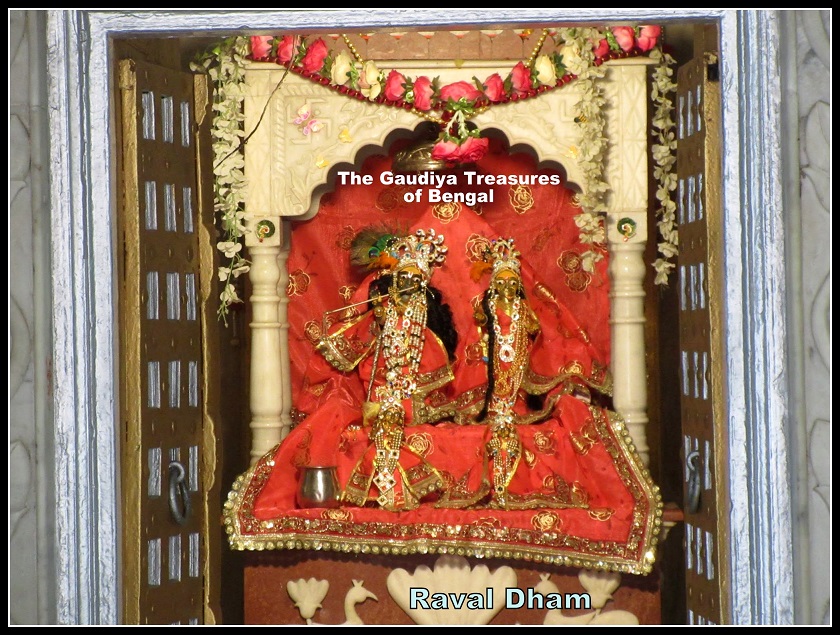
Raval dham is the birthplace of Srimati Radha rani. It is a small village on the bank of Yamuna and situated about 9 Kilometers from Mathura. Raval was formerly known as Mukhyeravali. In this village are worshiped the enchanting deities of Ladli-Lala (Radha and Krishna). The temple is found at a beautiful but lonely spot, about a Kilometer from the main road. The mesmerizing darshan of Ladli-Lala and the heartfelt devotion of the pilgrims have infused our hearts with divine ecstasy. The people at this place are spontaneously devoted toward Radha rani, whom they consider their little daughter. Sri Bhakti Ratnakara introduces Raval dham as follows –

Ohe Srinivas dekho e ‘Raval’ gram
Etha Vrishabhanu basati anupam
Sri Radhika prakata haila eikhane
Yahara prakate sukha byapila bhuvane
(Bhakti Ratnakara)

O Srinivasa, behold the village of Raval where King Vrishabhanu used to happily live. Srimati Radha rani had appeared over here and her appearance filled the whole world with divine rapture.

Categories
Gokul, Raval & Dauji Radha Krishna

Nand Bhavan Gokul (Chaurasi Khamba) – House of Nanda Maharaja

nand bhavan gokul krishna

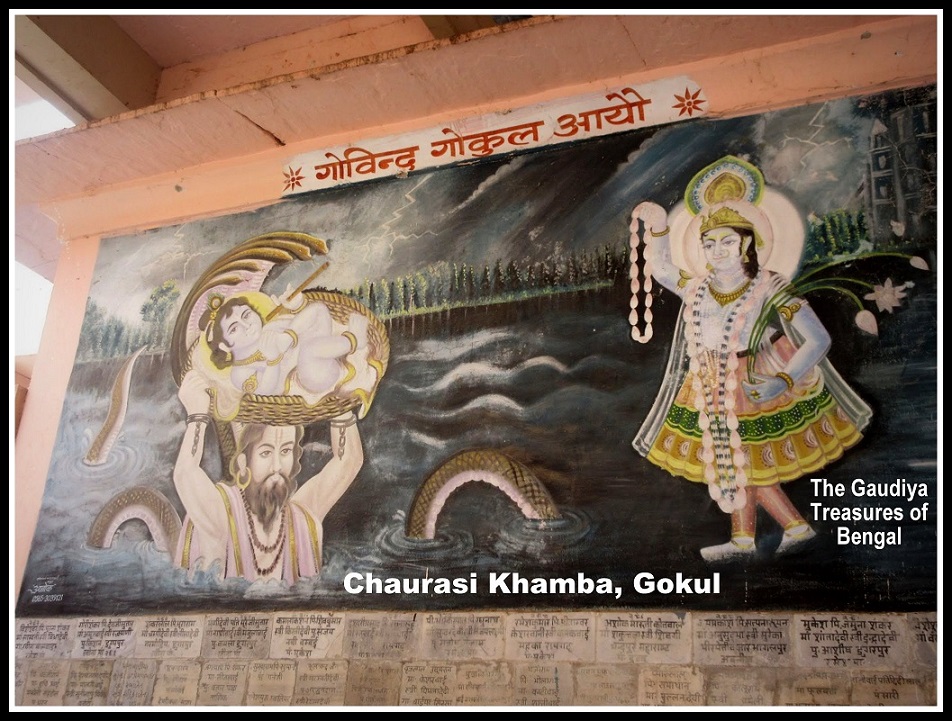
‘Nand Bhavan’ or ‘Chaurasi Khamba’, as it is sometimes referred to, is the ancient palace of Nanda Maharaja in Gokul Mahavan (near Mathura) where Krishna, Balarama, and the cowherd community resided until Krishna was three years and four months old. It was here at Nand Bhavan in Gokul, that Vasudeva had exchanged little Krishna with the daughter (Yogamaya) of Nanda Maharaja. So Nand Bhavan is the birthplace of Yogamaya devi. It was here at this house that Krishna and Balarama began crawling on their knees, performing their innumerable childhood pastimes. It was here that Krishna had killed and delivered the demons like Putana, Sakatasura, and Trinavarta. We have previously discussed Krishna’s Ukhal Bandhan Lila or Damodar pastime which had taken place where the ‘Ukhal Bandhan ashram’ is situated presently. Krishna’s mud-eating pastimes where He had revealed the entire universe to mother Yashoda in His mouth had occurred at a place called ‘Brahmand Ghat’, situated nearby on the banks of Yamuna. Chaurasi Khamba, Ukhal Bandhan Ashram and Brahmand Ghat were once all part of Nand Bhavan or Nanda Maharaja’s ancient residence. We have extensively discussed ‘Ukhal Bandhan Ashrama’ and ‘Brahmand Ghat’ previously. In this article, however, we are going to primarily focus on Nand Bhavan or Chaurasi Khamba.

Vraja gopa gopi dhaya aise e angane
Putra janma utsava haila eikhane
Bahu daan kaila Nanda putra kalyanete
Parama adbhuta sukha byapila jagate
(Bhakti Ratnakara)

The cowherd men and women of Vraja hurried to see Krishna at Nand Bhavan. The grand celebration of Krishna’s appearance was celebrated here at Nanda Bhavan where Nanda Maharaja distributed countless items in charity. A wonderful and ecstatic joy filled the entire world.

Categories
Gokul, Raval & Dauji

Ukhal Bandhan temple, Gokul Mahavan | Krishna’s Damodar Lila | Damodarastakam

ukhal bandhan damodar lila

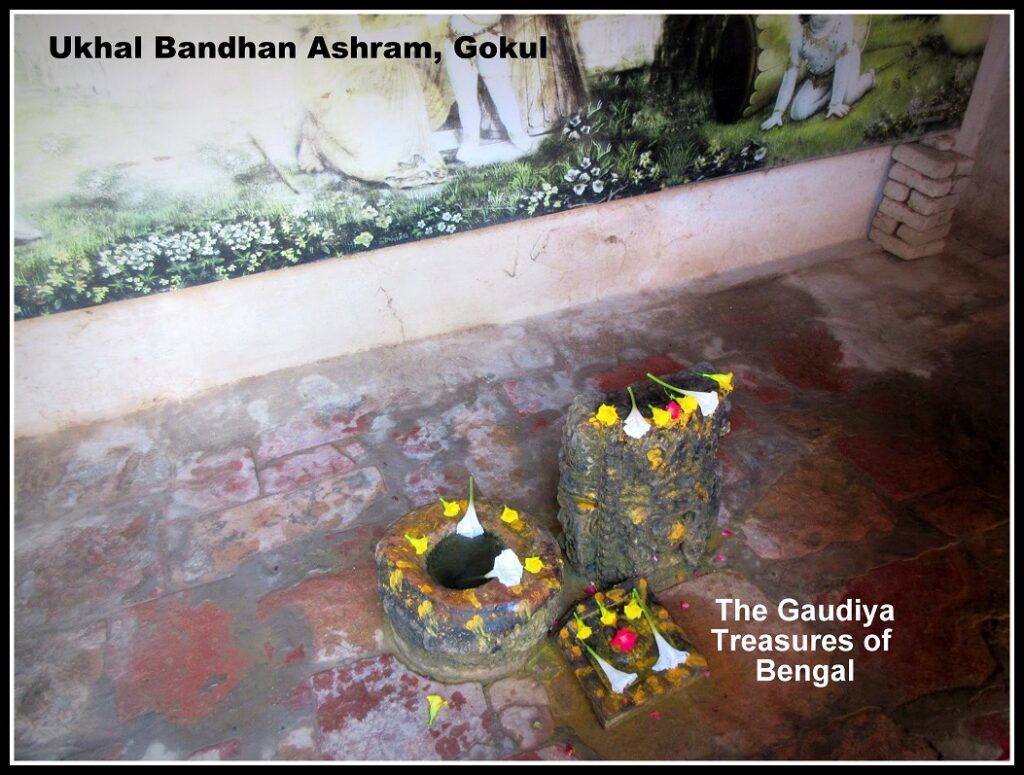
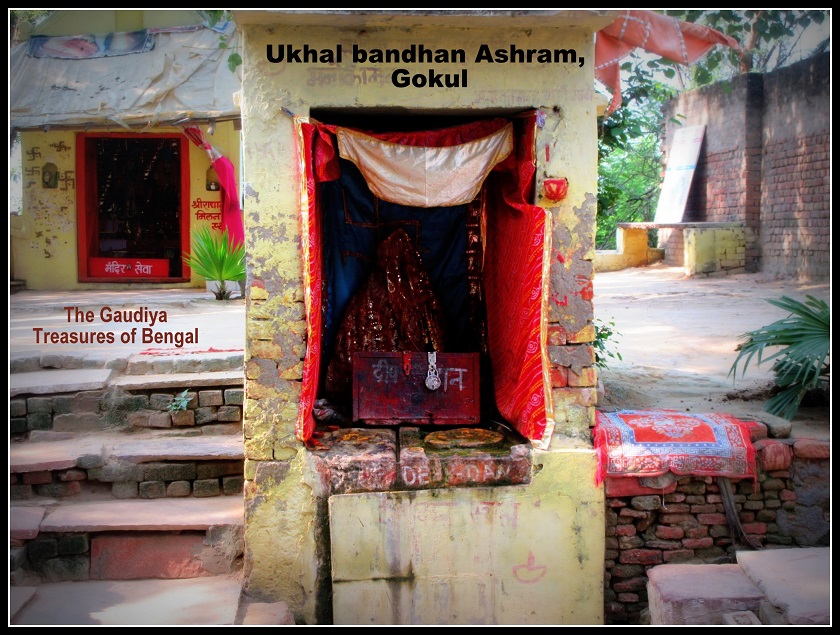
‘Ukhal Bandhan Ashram’ is the holy site where the Damodar lila of Lord Krishna had taken place. This ashram is situated within Gokul (or specifically old Gokul). It was once part of Nanda Maharaja’s courtyard. There is an old grinding mortar that is worshiped in this temple. The priests claim the grinding mortar to be from 5000 years ago when mother Yashoda had tied little Krishna to it. A grinding mortar is commonly referred to as ‘Ukhal’ in Hindi. Just beside the mortar is kept a small basket with which Vasudeva supposedly carried Krishna from Mathura to Gokul. The sweet pastime of baby Krishna stealing butter and subsequently being tied to a mortar by His dear mother Yashoda is also known as Damodara Lila. In Sanskrit, ‘dama’ means rope and ‘Udara’ means belly. Damodara refers to Krishna who was bound by ropes of affection by His mother Yashoda. It is also known as the ‘Ukhal Bandhan’ pastime as during the course of this pastime Krishna was tied with ropes to a ‘Ukhal’ or a grinding mortar. ‘Ukhal Bandhan’ ashram is situated within Mahavan, the eighth sacred forest of Vraja Mandala. Adi Varaha Purana glorifies Mahavan as follows –

Maha vanam castamam tu sadaiva hi mama priyam
Tasmin gatva tu manuja indraloke mahiyate

The eighth forest of Mahavan is very dear to me. One who goes there is worshiped on Indra’s planet.

Sri Chaitanya Mahaprabhu had visited Mahavan during His visit to Vraja Mandala and relished the pastimes of Krishna. Lord Chaitanya had manifested His ecstatic pastimes at this place.

ukhal bandhan damodar lila

Bhavabeshe prabhu nritya-geetite magna haila
Kripa kari sarva chitta akarshana kaila
Chaturdike dhaya loka dekhiya prabhure
Haiya adhairja Hari Hari dhvani kare
(Bhakti Ratnakara)

Sri Chaitanya manifested His singing and dancing pastimes here (at Mahavana) and mercifully enchanted the hearts of everyone. People rushed from all around to behold Mahaprabhu and chanted the holy names of Hari in ecstasy.

Sri Sanatana Goswami had also visited Mahavana and over here he had attained the divine darsana of Madana Gopal who displayed His pastimes as a cowherd boy to Sanatana.

Categories
Gokul, Raval & Dauji Radha Krishna

Brahmand Ghat, Gokul Mahavan – Krishna eats mud and shows His universal form to Yashoda

brahmand ghat gokul mahavan

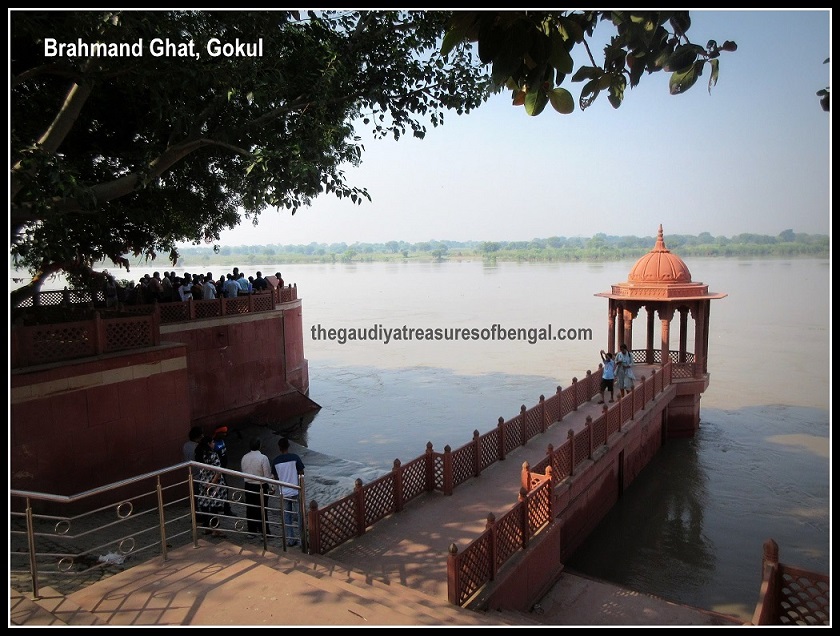
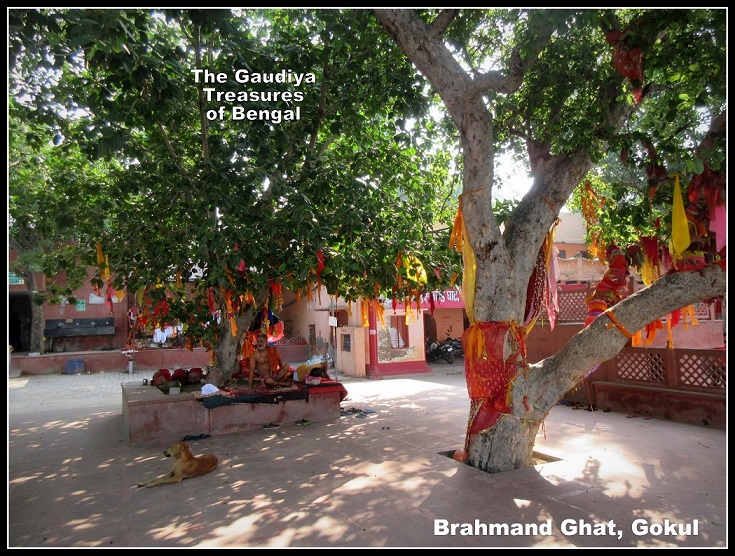
Brahmand Ghat is located about 15 Kilometers southeast of Mathura in the legendary town of Gokul. It falls within the precincts of Mahavan, the eighth sacred forest of Vraja Mandala. Located about 5 Kilometers from the ancient palace of Nanda Maharaja in Gokul (Nanda Bhavan), ‘Brahmanda Ghat’ is a tranquil stretch along the bank of river Yamuna. Brahmand Ghat was once a part of Nanda Maharaja’s courtyard and as infants, Krishna, Balarama, and other cowherd children came here to play. Brahmand Ghat is the site where infant Krishna, after consuming mud while playing with his friends, revealed the entire cosmos in his mouth, much to the bewilderment of his foster mother Yashoda. Hence the name of the place is Brahmand Ghat, literally meaning, the universe. Overseeing the Brahmand Ghat is a beautiful temple of Krishna, who is lovingly named ‘Sri Brahmand Bihari jiu’.  It is said that one who takes the darshan of Krishna at Brahmand Ghat, or one who takes bath in its waters, or one who eats mud at this sacred place, at once receives ecstatic love for Krishna. Adi Varaha Purana glorifies Mahavan as follows –

Maha vanam castamam tu sadaiva hi mama priyam
Tasmin gatva tu manuja indraloke mahiyate

The eighth forest of Mahavan is very dear to me. One who goes there is worshiped on Indra’s planet.

Sri Chaitanya Mahaprabhu had visited Mahavan during His visit to Vraja Mandala and relished the pastimes of Krishna. Lord Chaitanya had manifested His ecstatic pastimes at this place.

brahmand ghat gokul mahavan

Bhavabeshe prabhu nritya-geetite magna haila
Kripa kari sarva chitta akarshana kaila
Chaturdike dhaya loka dekhiya prabhure
Haiya adhairja Hari Hari dhvani kare
(Bhakti Ratnakara)

Sri Chaitanya manifested His singing and dancing pastimes here (at Mahavana) and mercifully enchanted the hearts of everyone. People rushed from all around to behold Mahaprabhu and chanted the holy names of Hari in ecstasy.

Sri Sanatana Goswami had also visited Mahavana and over here he had attained the divine darsana of Madana Gopal who displayed His pastimes as a cowherd boy to Sanatana.

Categories
Mathura, Madhuvan & Talavan

Balabhadra temple, Talavan (Tarsi), Mathura | Balarama kills Dhenukasura | Vraja Mandala

dauji balabhadra talavan vraja

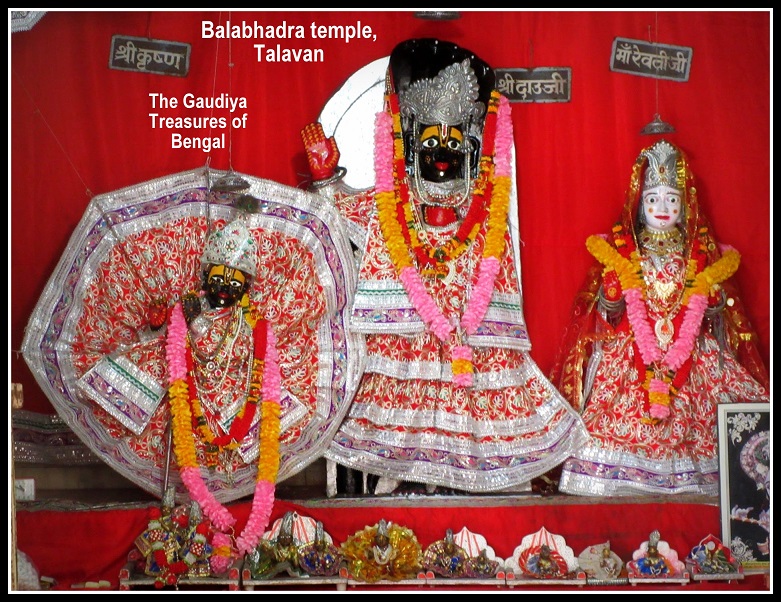
About 5 Kilometers south of Maholi (Madhuvan) and 10 Kilometers south of Mathura, is situated the village of Tarsi, whose ancient name was Talavan. Over here are worshiped beautiful deities of Lord Balarama (Dauji) and Revati devi. Next to the temple lies ‘Balabhadra Kunda’, which is also sometimes referred to as ‘Sankarshana Kunda’. It was over here in the forest of Talavan that Lord Balarama had killed demon Dhenukasura and his ass-demon associates. The place was previously filled with tall ‘Tala’ trees (palm trees) during Dvapara yuga and the region had thus derived its name. Presently Tarsi is not a forest anymore, and only a few Tala trees remain scattered here and there. Some of these Tala trees can be found today within the precincts of the temple compound. Talavan has been widely glorified throughout the Vedic scriptures. Skanda Purana states –

Aho tala vanam punyam yatra talair hato surah
Hitaya yadavanam ca atma kridanakaya ca

Ah, the forest of Talavan is highly auspicious. It is here that a demon (Dhenukasura) was killed by being thrown on a Tala tree for the benefit of the yadavas and for the purpose of the Lord’s play.

The forest of Talavan has been described in Sri Hari Vamsa as follows –

sa tu desah samah snigdhah
su mahan Krishna mrittikah
darbha prayah sthuli bhuto
lostra pasana varjitah

The land there (in Talavan) is smooth, and very wide. The ground is black, densely covered with darbha grass, and devoid of rocks and stones.

Categories
Mathura, Madhuvan & Talavan

Shatrughna temple & Lavanasura’s cave, Madhuvan (Maholi), Mathura | Vraja Mandala

shatrughna temple maholi mathura

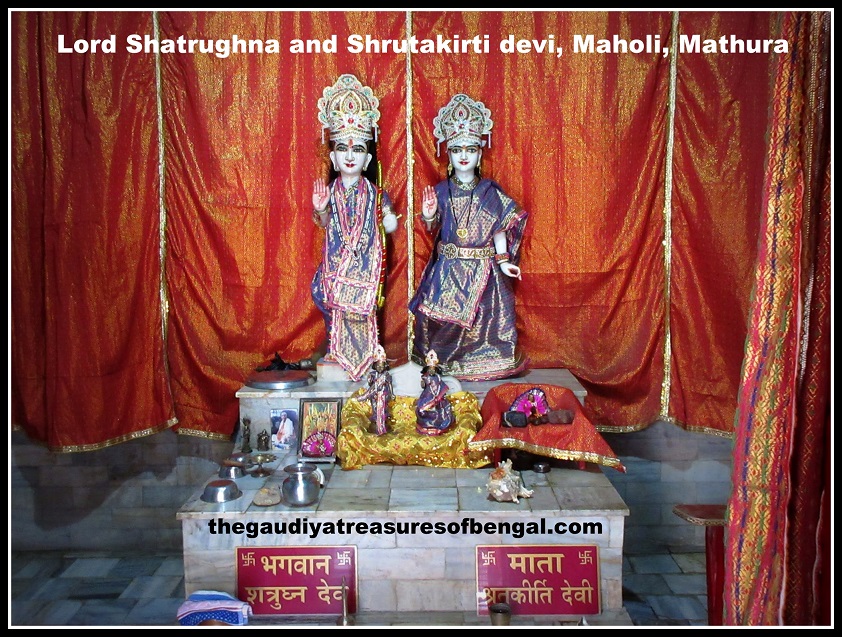
There is a small temple in Maholi dedicated to Shatrughna, the younger brother of Lord Rama, and Shrutakirti, Shatrughna’s wife. Shatrughna, the youngest brother of Rama, was the son of Dasaratha and Sumitra. The deity in this temple dates back to Treta Yuga. It was installed by local brahmanas after Shatrughna conquered Lavanasura and other demons. The cave where Lavanasura used to live is not far from the Shatrughna temple. One needs to carry a torch light to see clearly inside the demon’s cave. The village of Maholi is situated about six Kilometers southwest of Mathura and about four Kilometers west of Naroli. Maholi was earlier known as Madhuvan. It is here at Madhuvan that the Supreme Lord has been manifesting His enchanting pastimes millennium after millennium.

error: Content is protected !!